ContainerTurn
Los Angeles’s timing gap widened. Test import readiness against the export cutoff.
Written by ContainerTurn Editorial Team · Reviewed by ContainerTurn Operations Review · Published
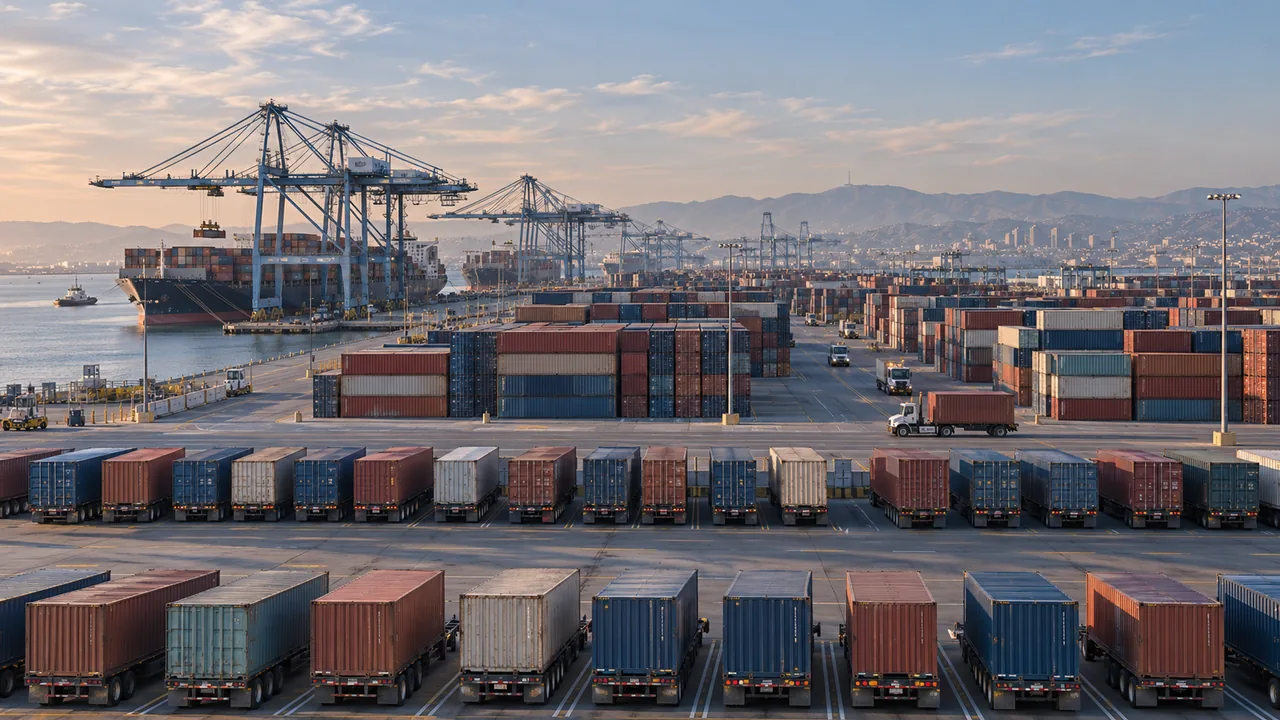
October data from the Port of Los Angeles and Descartes show why an import pickup and an export street-turn cutoff need separate confirmations.
The finding
At Los Angeles, Descartes’ arrival-to-CBP-data interval rose from 3.2 to 4.1 days in October while the port’s loaded imports eased 1.3% and outbound empty TEUs edged up 0.9%. For a proposed street turn, track the incoming container’s earliest verified empty-ready time separately from the export booking’s latest workable handoff.
What this changes operationally
Who should pay attention
Los Angeles importers, exporters, forwarders and dispatch teams pairing an import unload with an export booking.
What to check next
Set a decision deadline using the actual empty-ready time, export loading duration, travel, next available handoff and terminal cutoff. Keep a separately confirmed empty-release option when the usable window is too tight.
What this cannot prove
Descartes’ interval measures when it receives processed bill-of-lading data relative to the initial ETA. It cannot establish dwell, truck queues, release status or when an individual container will be empty. Outbound empty TEUs are movements, and equipment availability must be verified per booking.
How we got here
The port’s two flow series moved in opposite directions while the Descartes timing measure rose 0.9 day on displayed figures. None of those series gives the two booking-level timestamps needed to commit a turn.
Key measures
- Timing measure: 4.1 days · Descartes Figure 8. September was 3.2 days.
- Loaded imports: −1.3% · 545,695.60 → 538,619.65 TEUs.
- Outbound empties: +0.9% · 369,718.25 → 372,905.25 TEUs.
- Loaded exports: −8.6% · 125,750.75 → 114,980.75 TEUs.
What the October figures show
The port’s handling records show loaded imports fell by 7,075.95 TEUs. Dividing by September’s 545,695.60 gives a 1.3% decline. Outbound empty TEUs rose by 3,187, or 0.9%, while loaded export TEUs fell by 10,770, or 8.6%. The port release’s empty figure combines both directions. This analysis uses only outbound empties from the official statistics table.
Descartes separately reports Los Angeles at 2.7 days in August, 3.2 in September and 4.1 in October. It measures the interval from the initially declared estimated arrival on the bill of lading to its receipt of CBP-processed bill-of-lading data. Its series and the port table describe different events.
Work backward from the booking’s last usable window
Consider an illustrative export where the last usable gate time is 4 p.m. Thursday. If load, travel and handoff require five hours in total, the latest empty-ready time is 11 a.m. A verified 10 a.m. empty-ready time gives one hour of slack. If readiness moves to noon, the candidate misses the operating plan unless the parties can confirm a revised booking, gate time or workflow.
Build the timeline from confirmed events and leave a buffer for the lane’s own variability. Applying the 4.1-day research interval as a universal lead time would obscure where the actual constraint sits.
Checklist before assigning the import empty
A workable timeline and equipment-provider confirmation are both needed.
- Record when the import box can be picked up, stripped and confirmed empty-ready at the receiving facility.
- Confirm container size, type and condition, and get the equipment provider’s approval for the exact container and export booking.
- Check earliest export receiving, cutoff and the latest usable appointment. Work back using load, travel and handoff times.
- At the decision deadline, move to the confirmed alternate equipment plan if the import box, approval or window is still unresolved.
Original sources
- Descartes Datamyne, November Global Shipping Report, Figure 8 · August to October 2026 observations. Released November 11, 2026.
- Port of Los Angeles, official 2026 container statistics · September and October 2026 loaded imports and outbound flows.
- Port of Los Angeles, October cargo release · Published November 12, 2026.
Container logistics knowledge center · Dedicated drayage lane sourcing · Submit a private lane