ContainerTurn
JAXPORT’s tariff change is a line-item check for dedicated drayage bids
Written by ContainerTurn Editorial Team · Reviewed by ContainerTurn Operations Review · Published
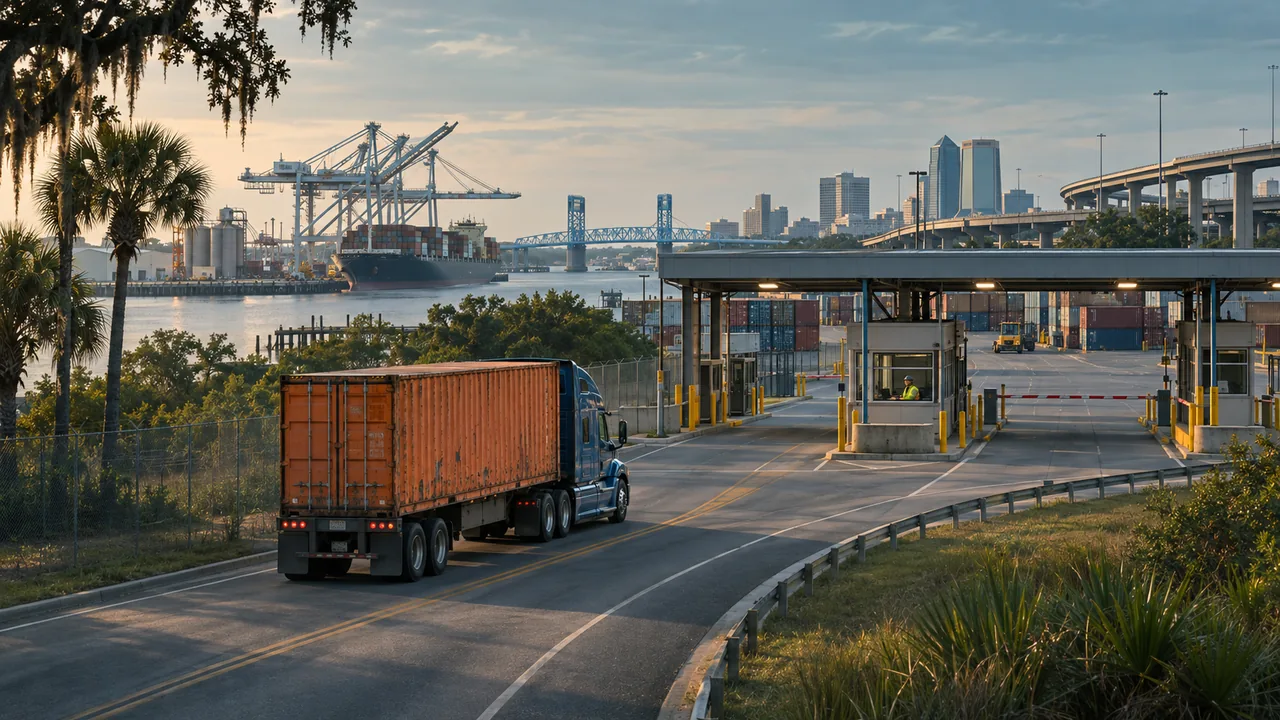
Use JAXPORT’s October tariff to identify which terminal charges may flow through a Jacksonville drayage quote and who is responsible for them.
The finding
JAXPORT announced a 3% general increase for most tariff items effective October 1 and listed several unchanged rules. A dedicated drayage quote should carry through only the charges that apply to the movement and that the contract assigns to the customer or carrier. Start with the specific terminal, rule, billing unit and payer.
What this changes operationally
Who should pay attention
Jacksonville shippers, brokers, forwarders and dispatch teams reviewing a recurring container move or a rate change.
What to check next
Ask which tariff item triggers the proposed price adjustment and cross-check its rule number, billing unit, invoice recipient and contract treatment. Keep the port authority’s own fuel rule separate from the carrier’s contracted truck fuel surcharge.
What this cannot prove
A port tariff is a schedule of charges for specified services and circumstances. The published increase alone cannot establish that a charge applies to a particular box, who pays it, or that a drayage carrier’s total price should rise by the same percentage.
How we got here
JAXPORT’s examples show changes at different charge levels and some unchanged rules. A line-item comparison exposes the actual dollar change before any pass-through is accepted.
Key measures
- General change: 3% · JAXPORT’s announced increase for most rates and services.
- Empty wharfage: +$0.77 · $25.69 → $26.46 per empty, Rule 31-455.
- Reefer plug charge: +$2.05 · $68.48 → $70.53 per plug per day, Rule 31-120.
- Selected exceptions: Unchanged · Rule 31-167 fuel surcharge and Rule 31-210 intermodal facility, per notice.
Read the schedule at the charge level
The port authority issued its notice September 1 for an October 1 effective date. The 2026 summary lists empty container wharfage at $26.46 per empty, compared with $25.69 in the prior published summary. It lists $70.53 per plug per day for the reefer electrical charge, versus $68.48 previously. These are examples of published charges and units. Wharfage should not be confused with a truck gate fee or assumed to be charged on each empty return.
The notice lists the port’s fuel surcharge rule and its intermodal transfer facility rule among unchanged items. A motor carrier may still calculate its own fuel surcharge under the lane contract. Match an invoice to the charging party and actual rule before attributing the change to JAXPORT.
Trace the change to the contract
For example, if a contract makes an applicable one-day reefer plug charge reimbursable at cost and the charge is documented, the difference in the published schedules is $2.05. If the shipment uses two billed plug days under the same conditions, the example difference is $4.10. The billing event and contract determine whether either number belongs in the quote.
Ask who pays each charge directly, who can pass it through, and how discrepancies are handled. An all-in quote should show which events were assumed in the base and which exceptions would trigger additional billing.
Checklist for a Jacksonville rate review
Request enough detail to reproduce the number on an example invoice.
- Identify the terminal or ramp, service date, equipment and shipment status.
- Ask for the tariff rule, billing unit and documentation behind the claimed adjustment.
- Verify whether the charge is direct-billed, already included, or reimbursable under the drayage contract.
- Keep the recurring linehaul, contractual fuel surcharge and event-driven terminal costs separate in the comparison.
Original sources
- JAXPORT, terminal tariff notice and current schedule · Notice issued September 1, 2026. Tariff effective October 1, 2026.
- JAXPORT, Tariff No. 2026 pricing summary · Effective October 1, 2026. Rules 31-455 and 31-120.
- JAXPORT, prior tariff pricing summary · 2025 schedule summary linked under Previous Tariffs.
Container logistics knowledge center · Dedicated drayage lane sourcing · Submit a private lane