ContainerTurn
How do local and OTR dedicated drayage lanes differ?
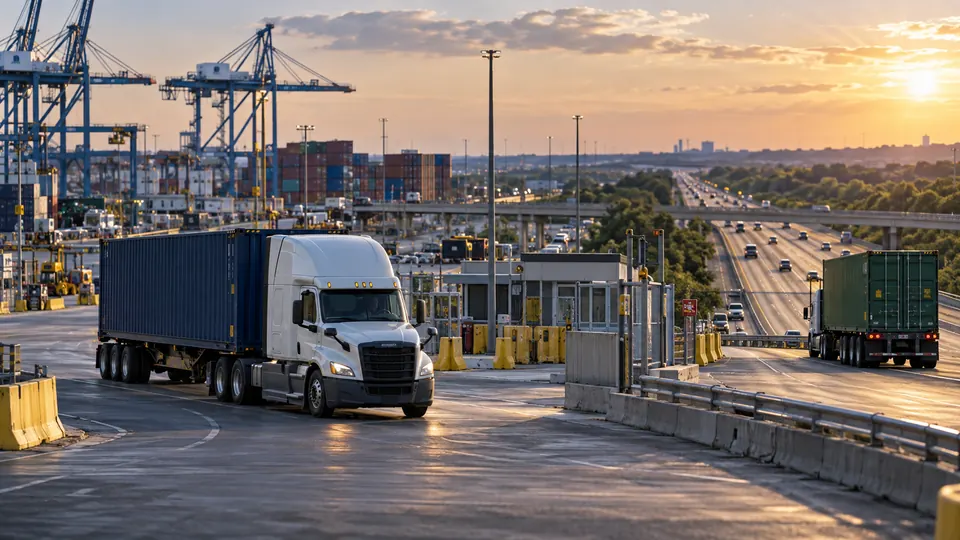
Local dedicated drayage centers on daily turns and gateway proximity; OTR dedicated container lanes require longer cycle planning, driver-hour control, equipment continuity and realistic round-trip capacity.
How does ContainerTurn address this?
A local dedicated drayage lane normally operates within the port or rail market and is planned around daily turns, terminal appointments, facility dwell and chassis cycles. An OTR dedicated container lane connects the gateway to a farther inland market and must account for linehaul distance, hours of service, layover or relay design, container and chassis detention, secure parking, delivery timing and the return movement. ContainerTurn treats both as recurring lane programs, but qualifies them against different operating constraints. Local and OTR drayage use the same container controls but very different capacity math. Local programs optimize turns per shift. OTR programs optimize complete round trips across driver hours, overnight requirements, chassis exposure and appointment reliability. Classify the cycle Map every loaded, empty and positioning leg rather than labeling by ZIP alone. Test driver time Include gate, road, warehouse, loading and return time under applicable hours limits. Design equipment continuity Confirm whether the container and chassis can travel inland and for how long. Set cadence Translate distance and cycle time into sustainable weekly capacity per tractor. Build recovery Identify supplemental capacity, relay or transload options before a failure. What is an OTR dedicated container lane? It is a recurring intermodal lane whose inland cycle requires linehaul-style planning beyond the immediate port or rail market. Can OTR dedicated lanes create street turns? Yes, and longer avoided empty legs may create greater value when recurring import and export patterns are compatible and approved. Is every regional lane OTR? No. The label should follow the actual operating cycle; ContainerTurn uses the underlying distance and time logic even when the public dashboard omits mileage. Actual one-way and round-trip operating distance. Driver-hour, layover, team, relay or overnight requirements. Port, rail, warehouse and return appointments. Chassis provider, allowed use area, free days and return obligation. Expected cadence, minimum volume and recovery capacity. Empty return, street-turn or loaded export continuation plan. A 30-mile port-to-warehouse lane may support multiple daily local turns. A 350-mile one-way inland lane may consume more than a day after gates, loading and return, so the same tractor cannot be promised at the same daily cadence. Using straight-line mileage instead of the complete operating cycle. Ignoring terminal and warehouse dwell in driver-hour planning. Assuming a marine chassis can remain inland without cost or restriction. Pricing OTR drayage as a simple local round trip. OTR is an operating classification, not a promise of any specific mileage. ContainerTurn validates whether the proposed cycle is realistic for the lane, driver, equipment and appointment pattern.
Questions this page answers
What is an OTR dedicated container lane?
It is a recurring intermodal lane whose inland cycle requires linehaul-style planning beyond the immediate port or rail market.
Can OTR dedicated lanes create street turns?
Yes, and longer avoided empty legs may create greater value when recurring import and export patterns are compatible and approved.
Is every regional lane OTR?
No. The label should follow the actual operating cycle; ContainerTurn uses the underlying distance and time logic even when the public dashboard omits mileage.
Written by ContainerTurn Editorial Team · Reviewed by ContainerTurn Operations Review · Last reviewed 2026-11-18
Container logistics knowledge center · Dedicated drayage lane sourcing · Submit a private lane